
| Processor | 1 hertz intel_core_i9 |
|---|---|
| RAM | 1 KB |
| Chipset brand | Intel |
| Card description | Integrated |
| Brand | ELEGOO |
| Series | 28BYJ-48 |
| Item model number | 28BYJ-48 |
| Hardware Platform | Linux |
| Operating System | Linux |
| Parcel Dimensions | 17.2 x 12 x 4.6 cm; 290 g |
| Processor Brand | Intel |
| Number of Processors | 1 |
| Memory Type | SRAM |
| Hard Disk Interface | ATA100 |
Prime Member Price
Ships from: 鶹 Sold by: ELEGOO Official CA
Non-Deal Price
To see product details, add this item to your cart.
Ships from: 鶹 Sold by: ELEGOO Official CA
Sorry, there was a problem.
There was an error retrieving your wish lists. Please try again.Sorry, there was a problem.
List unavailable.Image Unavailable
Colour:
-
-
-
- To view this video, download
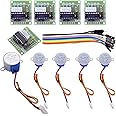
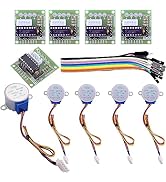
ELEGOO 5 Sets 28BYJ-48 ULN2003 5V Stepper Motor + ULN2003 Driver Board Compatible with Arduino
| Brand | ELEGOO |
| Operating system | Linux |
| CPU model | Intel Core i9 |
| CPU speed | 1 Hz |
| Graphics card description | Integrated |
| Specific uses for product | DIY Electronics, Robotics, Automation |
| Personal computer design type | Barebone |
| Model name | 28BYJ-48 |
| Included components | Stepper Motor + Driver Board |
| Special feature | Arduino Compatibility |
About this item
- Stepper motor with a standard interface, when used directly pluggable.
- A, B, C, D four-phase LED indicates the status of the stepper motor work.
- 5 line 4 phase can be used for ordinary ULN2003 chip driver, connect to the 2 phase , support the development board,With convenient use, direct docking
- Drive Module Board Size(in): 1.37*1.18*0.6 ; Stepper Motor diameter: 1.06(in) ; Stepper Motor lines: 9.45(in)
- Great packing in a box : 5 set Uln2003 Stepper Motor + Driver Board (with a little gift)
Product information
Technical Details
Summary
Additional Information
| ASIN | B0DWD524J4 |
|---|---|
| Customer Reviews |
5.0 out of 5 stars |
| Date First Available | Feb. 6 2025 |
| Manufacturer | ELEGOO |
Warranty & Support
Feedback
Videos for similar products
From the brand
-
ELEGOO STEM kits provide all the necessary components, sensors, wires, and boards for you to get started with programming, learning electronics, and creating IoT projects. We strive our best to make STEM education easy to learn and accessible to the young generation.
-
How we get our start?
Chris, the founder of ELEGOO, found out that most enterprises in the STEM industry focused on the hardware of open-source electronics and did not have tools to create a complete product by combining electronic hardware and structural shells.
What makes our products unique?
We have excellent R&D team, constantly upgrading and improving products, and after-sales service team for quick support.
What problem are we solving?
100% compatible with Arduino, ELEGOO's kits are best-practice for beginners who have no appropriate technical tools to learn about electronics.
-
Starter Kits
-
Electronic Component
-
Controller Boards
-
DIY Robotic Car Kits
-
DIY Robotic Car Kits
Product Description
Established in 2011, ELEGOO is a thriving technology company dedicated to open-source hardware research & development, production and marketing.
Our own Quality Management Team will secure the premium quality of our products and we would like to receive your valuable suggestions for our products and make your idea come true.
BYJ48 STEPPER MOTOR
Stepper Motor is a type of electromagnetic device which moves in discrete steps. This has several coils, the center shaft has a series of magnets mounted on it, and the coils surrounding the shaft are alternately given current or not, creating magnetic fields which repulse or attract the magnets on the shaft, causing the motor to rotate. This Unipolar Stepper Motor 28-BYJ48 is provided with five wires and four coils. The center connections of the coils are tied together and usually used as the power connection. They are named unipolar steppers because power always comes in on this one pole.
Specification
- A, B, C, D four-phase LED indicates the status of the stepper motor work.
- Stepper motor with a standard interface, when used directly pluggable.
- 5 line 4 phase can be used for ordinary ULN2003 chip driver, connect to the 2 phase , support the development board, with convenient use, direct docking.
- Rated Voltage: DC5V 4-phase
- Insulation Resistance: >10MΩ (500V)、Dielectric Strength: 600V AC / 1mA / 1s、Step angle: 5.625 x 1/64
- DC Resistance: 200Ω±7% (25C)、Reduction ratio: 1/64、Insulation Grade: A
- No-load Pull in Frequency: >600Hz、No-load Pull out Frequency: >1000Hz
- Pull in Torque: >34.3mN.m(120Hz)
- Detent Torque: >34.3mN.m
- Temperature Rise: < 40K(120Hz)
Programm Code Example The Arduino IDE support a library for stepper motor, after connect motor with microcontroller you can upload the sketch on to the microcontroller. The following is the code of an example program, it can be modified according to your needs: #define IN1 8 #define IN2 9 #define IN3 10 #define IN4 11 int Steps = 0; boolean Direction = true; void setup() { Serial.begin(9600); pinMode(IN1, OUTPUT); pinMode(IN2, OUTPUT); pinMode(IN3, OUTPUT); pinMode(IN4, OUTPUT); } void loop() { for(int i=0; i<4096; i++){ stepper(1); delayMicroseconds(800); } Direction = !Direction; } void stepper(int xw) { for (int x = 0; x < xw; x++) { switch (Steps) { case 0: digitalWrite(IN1, LOW); digitalWrite(IN2, LOW); digitalWrite(IN3, LOW); digitalWrite(IN4, HIGH); break; case 1: digitalWrite(IN1, LOW); digitalWrite(IN2, LOW); digitalWrite(IN3, HIGH); digitalWrite(IN4, HIGH); break; case 2: digitalWrite(IN1, LOW); digitalWrite(IN2, LOW); digitalWrite(IN3, HIGH); digitalWrite(IN4, LOW); break; case 3: digitalWrite(IN1, LOW); digitalWrite(IN2, HIGH); digitalWrite(IN3, HIGH); digitalWrite(IN4, LOW); break; case 4: digitalWrite(IN1, LOW); digitalWrite(IN2, HIGH); digitalWrite(IN3, LOW); digitalWrite(IN4, LOW); break; case 5: digitalWrite(IN1, HIGH); digitalWrite(IN2, HIGH); digitalWrite(IN3, LOW); digitalWrite(IN4, LOW); break; case 6: digitalWrite(IN1, HIGH); digitalWrite(IN2, LOW); digitalWrite(IN3, LOW); digitalWrite(IN4, LOW); break; case 7: digitalWrite(IN1, HIGH); digitalWrite(IN2, LOW); digitalWrite(IN3, LOW); digitalWrite(IN4, HIGH); break; default: digitalWrite(IN1, LOW); digitalWrite(IN2, LOW); digitalWrite(IN3, LOW); digitalWrite(IN4, LOW); break; } SetDirection(); } } void SetDirection() { if (Direction == 1) { Steps++; } if (Direction == 0) { Steps--; } if (Steps > 7) { Steps = 0; } if (Steps < 0) { Steps = 7; } }