
| Product Dimensions | 12.29 x 7.01 x 5.41 cm; 400 g |
|---|---|
| Batteries | 1 9V batteries required. |
| Item model number | EQ700 |
| Body Material | Plastic |
| Colour Name | Lt Yellow |
| Connector Type | 1/4 inch audio jack |
| Guitar pickup configuration | Piezo |
| Hardware interface | 1/4-inch Audio |
| Signal format | Analog |
| Number of strings | 1 |
| Material Type | Plastic |
| Country produced in | china |
| Power Source | Battery Powered or Electric Cable |
| Voltage | 9 |
| Item Weight | 400 g |

Image Unavailable
Colour:
-
-
-
- To view this video, download
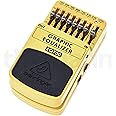
Behringer Graphic Equalizer EQ700 Effect Pedal
Purchase options and add-ons
| Brand | Behringer |
| Style | GRAPHIC EQUALIZER EQ700 |
| Colour | Lt Yellow |
| Product Dimensions | 12.3L x 7W x 5.4H Centimetres |
| Item weight | 0.88 Pounds |
| Voltage | 9 |
| Amperage | 0.3 Milliamps |
| Audio output effects | Compression, Flanger, Synthesizer, Reverb, Multiple Effect, Modulation, Preamp, Pitch Change, Overdrive, Choir, Distortion, Delay See more |
| Controls type | Knob |
| Power source | Battery Powered or Electric Cable |
About this item
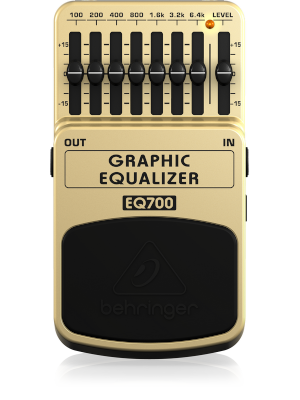
- Shape your sound and eliminate feedback with 7 bands of equalization
- Wide frequency range from 100 Hz to 6.4 kHz with a powerful 15dB boost/cut per band
- Status LED for effect on/off and battery check
- First-class electronic On/Off switch for noise-free operation
- Guitar/Keyboard
Frequently bought together

Videos for similar products
Product information
Technical Details
Additional Information
| ASIN | B000KIRT6A |
|---|---|
| Customer Reviews |
4.2 out of 5 stars |
| 鶹 Rank |
|
| Date First Available | Feb. 8 2012 |
| Manufacturer | Behringer |
| Place of Business | Montreal, QC H4R 2H4, CA |
Feedback
Product description
鶹.ca Product Description
Ultimate 7-Band Graphic Equalizer
From the Manufacturer
BEHRINGER GRAPHIC EQUALIZER EQ700
Ultimate 7-Band Graphic Equalizer
- Shape your sound and eliminate feedback with 7 bands of equalization
- This BEHRINGER product has been designed to compete head to head with leading products on the market
- Wide frequency range from 100 Hz to 6.4 kHz with a powerful 15 dB boost/cut per band
- Blue status LED for effect on/off and battery check
- Runs on 9 V battery or the BEHRINGER PSU-SB DC power supply (not included)
- First-class electronic On/Off switch for highest signal integrity in bypass mode
- High-quality components and exceptionally rugged construction ensure long life
- Conceived and designed by BEHRINGER Germany
Finding it hard to get the perfect sound from your guitar? Maybe your guitar gets lost in the mix? Do you have major feedback issues with your acoustic? The problem's not your guitar - you need an equalizer! The GRAPHIC EQUALIZER EQ700 provides total control over your tone and puts the brakes on annoying feedback, no matter what the performance situation. You can instantly improve the sound of your guitar with a little help from the BEHRINGER EQ700.
Master of Tone
With 15 dB of available boost or cut per band (that's a lot!), the EQ700's seven frequency bands have been carefully optimized to provide the ultimate tools for EQing the guitar. Of course, to make full use of the EQ700's capabilities, it helps to first understand some basics about the frequency range of your axe.
The EQ700 covers the audio spectrum from below 100 Hz to over 6.4 kHz, allowing you to effectively cut or boost specific frequencies to help focus your sound. Special attention has been paid to the critical midrange frequencies, which can make or break your tone. The following section offers tips that will have you sculpting the perfect guitar sound in no time at all.
Understanding EQ
Most performers don't have a clue about what good equalization can do for their sound. Maybe you've heard the old maxim, "Make a sine-wave to get really good sound," or "Make a smiley-face, that always works." Sadly, this qualifies as advice from the uninformed. Just as every room is unique, so is every musical instrument. Even guitars made by the same manufacturer, using the same materials, on the same day can vary a great deal.
People provide a good example of this principal - although we are all similar, we don't all wear the same size shoes, or even have the same color eyes. There is no one "perfect" equalization curve that fits every scenario; equalization is dynamic.
Applying EQ to the Guitar
Most acoustic and electric guitar energy lies between 100 Hz and 6.4 kHz. Even slight changes in this range can cause a tremendous variation in overall energy and impact, as the human ear is especially sensitive to this range.
Boosting frequencies around 200 Hz - 400 Hz often provides warmth and body, while boosting frequencies in the 3.2 kHz - 6.4 kHz range adds clarity to clean guitar signals. Depending on the amount of distortion, this same range can ruin the sound of an overdriven electric guitar by adding harsh harmonics.
One of the most common mistakes is adding too much bass to acoustic guitars. If the low frequencies are boosted excessively, acoustics can easily get lost in the overall mix. Most acoustic guitars are also prone to feedback in the 200 Hz - 400 Hz range.
A general rule of thumb - the best results are often achieved by finding and reducing the frequency bands that are offending, and then turning up the overall volume, rather than boosting one specific band.
How the specific frequency bands of the EQ700 can shape your sound
- 100 Hz (low bass) Boost: To add fullness to guitars, especially clean electrics Cut: To reduce muddy or boomy tone and control acoustic guitar feedback
- 200 Hz (soft bass) Boost: To increase the warmth of all guitars and provide a slightly harder sound Cut: To increase clarity and reduce feedback in acoustic guitars
- 400 Hz (hard bass) Boost: To add definition to rhythm parts Cut: To reduce feedback in acoustic guitars (This is a major feedback zone for piezo-equipped flattops)
- 800 Hz Boost: To add an aggressive edge to the overall sound Cut: For reducing the nasal or horn-like content, often referred to as the "cheap guitar" syndrome
- 1.6 kHz Boost: To make the guitar cut through the mix. Creates a more distinctive plucked tone Cut: To eliminate dullness and competition with vocals (vocal fundamentals occupy the range from about 1.0 kHz - 2.5 kHz)
- 3.2 kHz Boost: To add significant attack to all guitars. Creates an even more distinctive plucked tone Cut: To eliminate harshness
- 6.4 kHz Boost: To add edge and increase brightness to all guitars Cut: To soften thin-sounding guitars and remove string squeak
Top Brand: Behringer
From the manufacturer
Special attention has been paid to the critical midrange frequencies, which can easily make or break your tone. The following section offers tips that will have you sculpting the perfect guitar sound in no time at all.
BEHRINGER Graphic Equalizer EQ700
Ultimate 7-Band Graphic Equalizer
With 15 dB of available boost or cut per band, the EQ700’s seven frequency bands were carefully optimized to provide the ultimate tools for EQ’ing your guitar. Of course, to make full use of the EQ700’s capabilities, it helps to first understand some basics about the frequency range of your axe. The EQ700 covers the audio spectrum from below 100 Hz to over 6.4 kHz, allowing you to effectively cut or boost a slew of frequencies to help bring focus to your sound.
- Shape your sound and eliminate feedback with 7 bands of equalization
- This BEHRINGER product has been designed to compete head to head with leading products on the market
- Wide frequency range from 100 Hz to 6.4 kHz with a powerful 15 dB boost/cut per band
- Status LED for effect on/off and battery check
- Runs on 9 V battery or the BEHRINGER PSU-SB DC power supply (not included)
- First-class electronic on/off switch for highest signal integrity in bypass mode
How the specific frequency bands of the EQ700 can shape your sound:
100 Hz (low bass) Boost: To add fullness to guitars, especially clean electrics Cut: To reduce muddy or boomy tone and control acoustic guitar feedback 200 Hz (soft bass) Boost: To increase the warmth of all guitars and provide a slightly harder sound Cut: To increase clarity and reduce feedback in acoustic guitars 400 Hz (hard bass) Boost: To add definition to rhythm parts Cut: To reduce feedback in acoustic guitars (This is a major feedback zone for piezo-equipped flattops) 800 Hz Boost: To add an aggressive edge to the overall sound Cut: For reducing the nasal or horn-like content, often referred to as the “cheap guitar” syndrome 1.6 kHz Boost: To make the guitar cut through the mix. Creates a more distinctive plucked tone Cut: To eliminate dullness and competition with vocals (vocal fundamentals occupy the range from about 1.0 kHz - 2.5 kHz) 3.2 kHz Boost: To add significant attack to all guitars. Creates an even more distinctive plucked tone Cut: To eliminate harshness 6.4 kHz Boost: To add edge and increase brightness to all guitars Cut: To soften thin-sounding guitars and remove string squeak
Sound Value
The EQ700 offers more features than anything in its class – and it's kind to your wallet! From its easy– to-use controls, to its noise-free On/Off switch – the EQ700 will keep you solidly in the zone. Try one out at your local dealer, and see just how good you and your guitar can sound.